
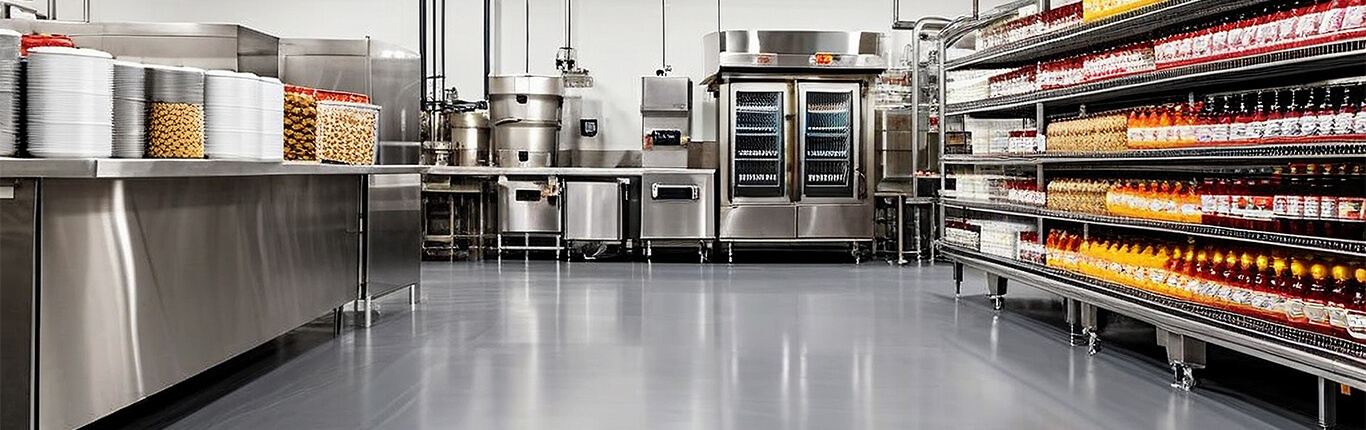
In commercial kitchens, the floor is exposed to more stress than almost any other surface. It deals with hot water, grease, food waste, cleaning chemicals, and constant movement from staff and equipment. These conditions don’t occur occasionally. They happen every day.
When the floor surface cannot handle this, hygiene issues follow quickly. Moisture finds its way into small cracks. Food residue builds up in joints. Cleaning becomes less effective, no matter how often it’s done. Over time, the problem isn’t housekeeping. It’s the flooring itself.
This is why polyurethane concrete flooring is increasingly used as the preferred flooring for commercial kitchens.
Why Commercial Kitchen Floors Become a Hygiene Risk
Many kitchens still use ceramic tiles or standard resin coatings. Both options have weaknesses in real kitchen environments.
Tiles rely on grout, which absorbs grease and moisture. Resin coatings, especially basic epoxy, can soften or crack under heat and frequent wash-downs. Once that happens, bacteria and odours are difficult to control.
Typical issues include:
- Damp patches that don’t dry properly.
- Slippery areas during cleaning.
- Staining from oils and food acids.
- Repeated local repairs that never fully solve the issue.
At that stage, hygiene failures are only a matter of time.
What Polyurethane Concrete Flooring Is
Polyurethane concrete flooring is a cement-based system modified with polyurethane resin. A thick, continuous layer of polymer concrete is installed upon concrete to form an excellent bond to the concrete substrate.
Polyurethane coatings do not just rest upon the surface; they are integrated into the flooring system itself. As a result, it has much more stability against heat, moisture, and mechanical stress than other types of coatings.
Why Polyurethane Concrete Works in Kitchens
Polyurethane concrete has been utilized in many commercial kitchen floor applications where both hygiene and durability are essential. This product has many unique characteristics that provide many benefits as they relate to commercial kitchens.
It resists cleaning chemicals. Degreasers, disinfectants, and detergents used daily in kitchens do not damage the surface.
It tolerates heat. Hot water wash-downs and steam cleaning do not cause cracking or debonding. Sudden temperature changes are not a problem.
Slip resistance can be built into the surface. Even in wet conditions, the floor remains safer to walk on without becoming difficult to clean.
Once installed, the floor remains stable for years, which reduces maintenance work and unplanned shutdowns.
Polyurethane Concrete Compared to Epoxy in Kitchens
Epoxy flooring systems are often used in food facilities, but kitchens place epoxy under constant stress.
Epoxy performs well in dry, temperature-controlled environments. In kitchens, repeated exposure to heat, water, and aggressive cleaning can shorten its service life.
Polyurethane concrete is more tolerant of these conditions. For this reason, many facilities use epoxy in dry storage or prep rooms, and polyurethane concrete in cooking, washing, and wet zones.
Dr Cipy’s Polyurethane Concrete Flooring
Dr Cipy supplies polyurethane concrete flooring systems designed for hygiene-sensitive environments. Their systems are used in commercial kitchens, food processing plants, dairies, and beverage facilities where floors are exposed to heat, moisture, and chemicals on a daily basis.
The focus is on correct surface preparation, proper installation, and long-term performance. When applied correctly, the flooring remains easy to clean and stable under operating conditions common to commercial kitchens.
Conclusion
In a commercial kitchen, flooring is not a background element. It directly affects hygiene, safety, and maintenance effort.
Polyurethane concrete flooring offers a reliable solution where heat, moisture, chemicals, and cleaning are part of daily operations. It stays seamless, resists damage, and supports consistent hygiene standards over time.
For kitchens with cracked or slippery floors, avoiding repeated hygiene problems, polyurethane concrete is the most efficient long-term solution available.
FAQs
When a floor is damaged and porous, food and water will be absorbed into the floor, allowing for difficulties in being able to have all of the areas within a commercial kitchen cleaned and sanitized properly.
Polyurethane concrete has a seamless finish, is heat/chemical resistant, and has a long lifespan, which makes it appropriate for the extreme conditions that exist within all commercial kitchens.
Yes, Polyurethane concrete flooring is manufactured to be able to withstand steam cleaning, hot water cleaning, and thermal shock daily due to rapid changes in temperature.
Yes. When installed correctly, Polyurethane concrete can be used as a non-porous and hygienic surface; therefore, it is safe for food preparation.