
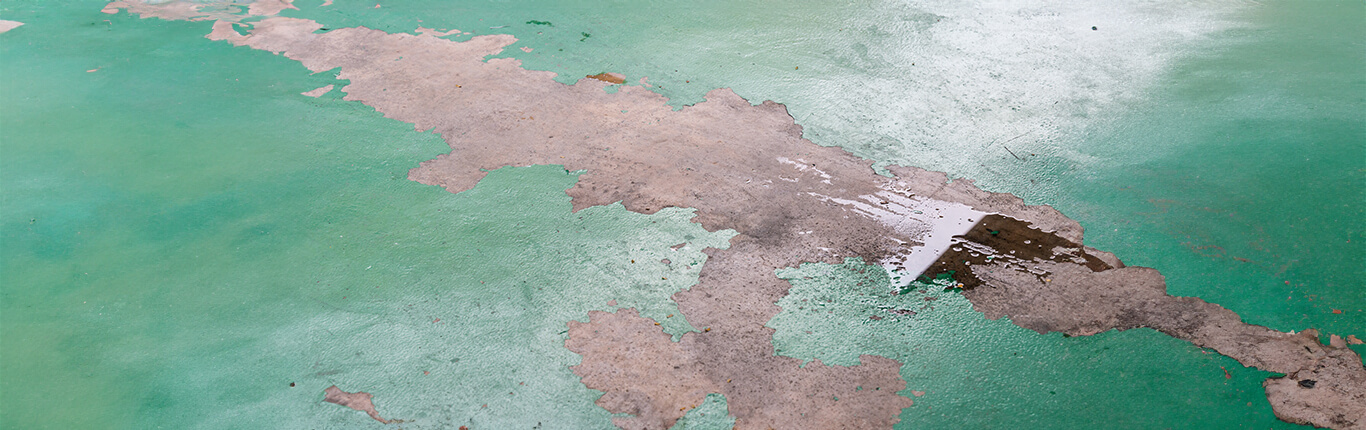
Epoxy flooring is supposed to be the low-maintenance, long-lasting solution. That’s the whole point of choosing it. It handles traffic, resists chemicals, looks clean, and holds up where regular flooring simply doesn’t. So when it starts peeling or flaking, it can be confusing because it wasn’t supposed to do this.
Here’s the uncomfortable truth. Peeling rarely comes from one glaring mistake. It’s usually a string of small oversights that only show up months after the floor was laid.
Let’s get into what’s actually happening and what to do about it.
What Does Epoxy Floor Peeling Really Mean?
Peeling is not a surface-level problem. It’s a bond failure, which means the epoxy coating is separating from the concrete substrate beneath it. Once that bond weakens, the coating has no choice but to lift, crack, or come away in sections.
You might be seeing:
- Thin flakes are coming off in high-traffic areas.
- Bubbles or blisters forming under the coating.
- Entire sections lifting cleanly from the floor.
Each of these is a symptom of the same thing: the floor wasn’t prepared, applied, or maintained the way it should have been.
1. Poor Surface Preparation
Surface prep is the first step and an important one. It’s also the step that gets rushed most often.
Concrete needs to be mechanically opened up before epoxy goes down. If there’s dust, oil, residue from old coatings, or even a smooth sealed surface, the epoxy doesn’t actually bond. It just sits on top and waits to fail.
Where things go wrong:
- No grinding or shot blasting before application.
- Inadequate cleaning.
- Applying epoxy over a polished or sealed surface.
Fix:
- Strip the failed coating completely before doing anything else.
- Use diamond grinding or shot blasting to create the right surface profile.
- Match the concrete profile to what the specific epoxy system actually requires.
Skipping proper surface preparation for epoxy flooring is the fastest route to a floor that looks fine for three months and falls apart by six.
2. Moisture in the Concrete
Concrete holds moisture internally, and when vapor pressure builds up beneath a sealed coating, it pushes upward. The epoxy can’t go anywhere, so it blisters, then bubbles, then peels.
Signs:
- Blistering or bubbling, especially in patches.
- Peeling concentrated in ground-floor or basement areas.
Fix:
- Always conduct moisture testing before any epoxy application.
- Use vapor-resistant primers or moisture barriers where needed.
- In cases of high vapor emission, switch to a moisture-tolerant system entirely.
Moisture is consistently one of the top drivers of epoxy floor peeling, and it’s almost entirely preventable with the right testing upfront.
3. Incorrect Mixing Ratios
Epoxy is a two-component system that consists of a resin and a hardener. They need to be combined in exact proportions for the chemical reaction to complete properly. This isn’t a situation where close enough works.
What happens:
- The coating stays too soft or becomes brittle after curing.
- Adhesion degrades over time rather than holding.
Fix:
- Follow the manufacturer’s specified mix ratio.
- Use calibrated equipment.
- Don’t try to stretch a batch or adjust ratios on-site.
Even a small deviation compounds into large-scale epoxy floor peeling repair problems down the line.
4. Application on a Contaminated Surface
The surface can look spotless and still be contaminated.
Oil residues, chemical spills, and curing compounds used during concrete finishing don’t always leave visible traces. But they’re enough to prevent the epoxy from bonding properly.
Common mistakes:
- Skipping the degreasing step entirely.
- Not testing the surface before coating.
- Rushing the application right after cleaning, without adequate drying time.
Fix:
- Use industrial-grade degreasers.
- Run surface contamination tests before applying anything.
- Give the surface enough time to dry completely after prep.
These are classic floor coating application errors. They’re easy to overlook, especially on a tight project timeline.
5. Improper Curing Conditions
Epoxy doesn’t cure in a vacuum. Temperature, humidity, and airflow all affect how the coating sets, and getting it wrong has consequences.
Risk factors:
- High ambient humidity during or after application.
- Cold temperatures are slowing the cure too much.
- Sudden changes in the environment mid-cure.
Fix:
- Stay within the manufacturer’s recommended temperature and humidity window.
- Avoid application during extreme or unpredictable weather.
- Use environmental controls indoors where conditions can be managed.
Curing conditions are easy to dismiss as minor factors. Poor curing is a slow-burning cause of epoxy floor peeling that shows up long after the job is signed off.
6. Applying Epoxy Over Weak Concrete
The epoxy bonds to whatever is directly beneath it. If that layer is weak, crumbly, or full of laitance, the coating bonds to that weak layer.
Result:
- The coating peels, and it brings part of the concrete surface with it.
Fix:
- Repair cracks and structural damage before coating.
- Remove laitance and weak surface layers through grinding.
- Reinforce or stabilise the substrate if the base concrete is compromised.
Laying epoxy over a weak base and hoping it holds is one of the more common causes of premature epoxy floor failure.
7. Excessive Load or Impact
Even a well-installed epoxy floor has its limits. Sustained heavy loads, dragged equipment, or repeated impact stress will eventually overcome the coating’s capacity, particularly if the system wasn’t prepared correctly for the environment.
What happens:
- Cracks develop at stress points.
- Edges begin to lift.
- Peeling radiates outward from high-impact zones.
Fix:
- Select the right system thickness and formulation for the actual load conditions.
- Add protective topcoats in areas with heavy machinery or frequent impact.
- Plan the flooring spec around how the space is actually going to be used.
Can You Fix a Peeling Epoxy Floor?
Yes, but the right approach depends entirely on how far the damage has gone.
- Minor peeling: Sand the affected area back and recoat.
- Moderate damage: Remove the damaged sections, re-prep the substrate, and reapply.
- Severe failure: Full removal and reinstallation.
One thing worth noting: patching over a peeling floor without addressing the root cause almost always fails again. Sometimes faster than the first time.
Why Professional Installation Matters
Most peeling problems aren’t material failures. They’re installation failures.
A properly installed epoxy floor should:
- Bond consistently and strongly to the substrate.
- Resist moisture and chemical exposure over the long term.
- Withstand the operational loads it was designed for.
Every phase of the process, from surface testing and substrate repair to application technique and cure time management, requires precision and experience. Cutting corners at any stage shows up eventually.
At Dr. Cipy, epoxy flooring systems are designed around the actual conditions of each facility, not a generic installation checklist. The focus is on getting the substrate right, selecting the correct system, and applying it properly, so the floor performs the way it’s supposed to, for as long as it’s supposed to.
Conclusion
Epoxy floor peeling doesn’t happen all at once. It builds from skipped steps, unsuitable conditions, and decisions made quickly during installation that only become obvious months later.
Understanding the actual cause makes the fix straightforward. Whether it’s a moisture issue, a surface prep problem, or an application error, resolving it at the source is the only approach that actually works.
If your floor is already showing signs of failure, get a proper assessment before attempting repairs. A well-installed epoxy floor holds up for 7–15 years or more. If yours isn’t getting there, something went wrong early, and it’s worth finding out what.
FAQs
Poor surface preparation, moisture in the concrete, incorrect mixing ratios, and inadequate curing conditions are the leading causes.
Yes, moisture trapped in concrete creates vapor pressure beneath the coating, which causes blistering and eventual peeling. A simple moisture test before application can prevent this entirely.
The damaged coating has to come off first. Then the substrate needs to be properly prepared before fresh epoxy is applied under the right conditions. Skipping any of these steps means the repair won’t hold either.
In cases of minor, localised peeling, yes — targeted repairs can work. But only if the underlying cause has been identified and resolved. Patching a floor without fixing the root problem just delays the next failure.
A properly installed epoxy floor typically lasts 7–15 years or more without peeling, depending on traffic levels, chemical exposure, and maintenance. Peeling well before that window usually points to an installation issue.